Controlled AI. Real results.
Digital Operations for investigations and intelligence work
Arqent Core puts AI operators to work inside the case: they collect and analyse OSINT, darknet and financial signals, correlate findings and draft the briefing. Every finding keeps its source, every result is checked independently, and analysts decide what leaves the case – on-premises or fully airgapped.
See it run
Watch an operator work an OSINT case
From the reported account to the briefing: collection, correlation, an independent check and the analyst decision – all inside the case.
Steps
Operator
OSINT analyst operator
Goal
The operator starts as soon as the goal is set.
Simulated run with illustrative data.
Mission areas
Where government and security teams use Arqent Core
The same case model, the same controls and the same deployment options – applied to different missions.
FRAGMENTED CASE WORK
Government investigations
Leads, files, OSINT, darknet context, analyst notes and reports end up in one case instead of separate systems.
Learn MoreOPEN SOURCES, ASSESSED
OSINT analysis
Operators collect open sources, check every hit for false positives and deliver an assessment with source notes.
Learn MoreONE OPERATING PICTURE
Critical infrastructure
Events, hazards and incidents next to your sites – with what changed, what it affects and who decided what.
Learn MoreTOO MANY POINT TOOLS
Corporate security and threat intelligence
Your sources and vendors stay. Operators turn lookups into governed, repeatable intelligence work.
Learn MoreFAST, REVIEWABLE TRIAGE
Financial crime and fraud
Email, wallet, domain, account, sanctions and darknet signals connected quickly – with the reviewer in control.
Learn MorePEOPLE, PLACES, EVENTS
Executive protection
Concise, reviewable risk context around people, locations and events before an operation moves.
Learn MoreUse cases
What operators take over in the case
Collection, analysis, correlation and monitoring – with sources, independent checks and analyst approval.
Investigations
Case-native investigations
From the first lead to the final briefing, operators collect, enrich and correlate inside the case. Sources, findings, analyst decisions and reports stay in one record instead of chats, spreadsheets and point tools.
Explore workflowSystems and sources
What the operator does
Results
OSINT
OSINT analysis
Operators collect and assess open sources – usernames, email registrations, domains, social and messaging channels including Telegram, and commercial OSINT such as Fivecast ONYX. Every hit gets a source note and a false-positive check before it becomes a finding.
Explore workflowSystems and sources
What the operator does
Results
Threat intelligence
Darknet intelligence
Find and map onion services, marketplaces, vendors and indicators – with darknet search, an isolated Tor browser and analysis of the Tor relay network. Collection stays governed, and every artifact stays attached to the case.
Explore workflowSystems and sources
What the operator does
Results
Financial investigations
Crypto wallet intelligence
Wallets found on the darknet or in seized material are analysed, linked wallets are traced and connected to actors, accounts and domains in the case graph.
Explore workflowSystems and sources
What the operator does
Results
Financial crime and compliance
Sanctions screening
Persons, organisations, vessels and aircraft are screened against sanctions lists. Matches, list entries and the reviewer decision are documented in the case.
Discuss this use caseSystems and sources
What the operator does
Results
Fraud and DFIR
Email forensics and BEC
A suspicious email is analysed – headers, domains, links and attachments – enriched, correlated with the case and turned into a report a reviewer can stand behind.
Explore workflowSystems and sources
What the operator does
Results
OSINT
Account and identity investigations
Username and account signals across platforms are compared, false positives are marked, and the remaining hits are connected into an identity graph with source notes.
Explore workflowSystems and sources
What the operator does
Results
Digital forensics
Image and media forensics
Images are checked for metadata, hidden content and manipulation, text is extracted and translated, and a sanitized copy plus a signed evidence bundle go into the case.
Discuss this use caseSystems and sources
What the operator does
Results
Critical infrastructure
Situational awareness for critical sites
Global events, natural hazards and incidents appear on one live map next to your sites. Geofences with NATO symbology (APP-6) mark what matters, and operators report what changed and what it affects.
Explore workflowSystems and sources
What the operator does
Results
Protection of sites and events
Drone and radio detection
Connected sensors pick up drone Remote ID, aircraft ADS-B, Bluetooth and radio signals. Detections appear on a live map, flights can be tracked, and operators flag what needs attention.
Discuss this use caseSystems and sources
What the operator does
Results
Monitoring
Continuous monitoring
Operators watch targets, topics and sources on a schedule – day and night – and report only what changed, with the evidence attached. Repeated failures escalate to a person.
Discuss this use caseSystems and sources
What the operator does
Results
Classified environments
Airgapped intelligence
The full platform runs without any connection to the outside – with local models, local evidence storage and the same checks and approvals as everywhere else.
Explore workflowSystems and sources
What the operator does
Results
Platform teams
External tool orchestration
Your team already owns tools and data sources. Arqent wraps them as governed tools: a policy check before every call, a full execution history and results that land in the case.
Explore workflowSystems and sources
What the operator does
Results
Security compliance
Control documentation for security frameworks
Import NIST 800-53 and FedRAMP baselines, document each control with four-eyes review and export a validated system security plan for your own systems.
Discuss this use caseSystems and sources
What the operator does
Results
Why Arqent Core
Built for work that has to hold up in review
ONE RECORD
Case-bound
Operators work inside the case. Sources, tool calls, findings and decisions stay in one record from intake to briefing.
BLIND REVIEW
Independently checked
A separate review re-checks results against the agreed criteria before they count – and marks what does not hold up.
HUMAN APPROVAL
Analyst decides
Nothing leaves the case and no critical action runs without the analyst. Every decision is recorded.
NO OUTSIDE CONNECTION
Runs airgapped
The full platform runs on-premises or fully airgapped with local models – for classified and isolated environments.
Product view
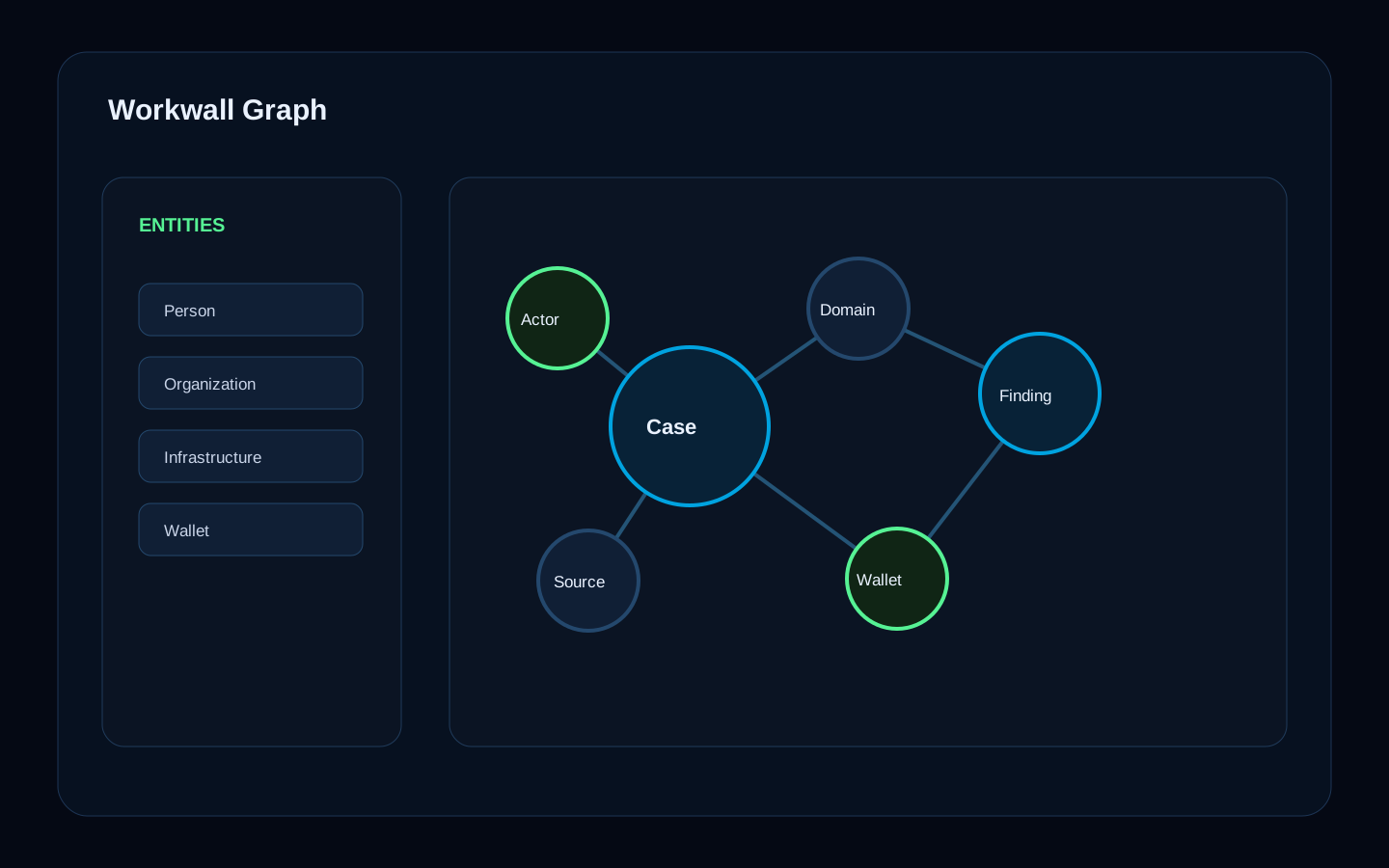
Findings become a case graph, not a chat history
People, accounts, domains, wallets, locations, reports and artifacts are connected in the case graph – with the source behind every link.
Entities
Actors, accounts, domains, wallets and locations
Artifacts
Files, screenshots, tool outputs and reports
Relations
Why one finding matters to another
Review
What was checked, approved and exported
CASE GRAPH
Findings become connected context
Evaluation path
What the next 90 days can look like
A procurement-friendly path for teams that need to check mission fit, deployment and security before rollout.
SCOPED DEMO
Week 1
A focused walkthrough for your mission area, data boundary and current toolchain.
Learn MoreSECURITY AND DEPLOYMENT REVIEW
Week 4
Deployment topology, access model, evidence handling and approval paths reviewed with your security and procurement teams.
Learn MorePILOT IN YOUR ENVIRONMENT
Week 12
A bounded pilot in the target environment – on-premises or airgapped – with operators, checks and analyst workflow.
Learn MoreMap your mission workflow
Bring the case type, your sources, your review steps and your deployment boundary. We show how operators take it over.