Controlled AI. Real results.
Give protection teams risk context before movement starts
Protection work depends on timely context, but raw public signals are noisy. Teams need to know what changed around a person, place, event or actor and how confident the assessment is before they adjust plans.
Product view
Organize risk context around people, places and events
Protective intelligence teams can connect public signals, locations, events, actors and source notes into a reviewable operating picture before movement begins.
People
Protected persons, staff, actors and accounts
Places
Venues, routes, facilities and public locations
Events
Travel, appearances, incidents and schedule changes
Briefings
Risk context, confidence and review notes
CASE GRAPH
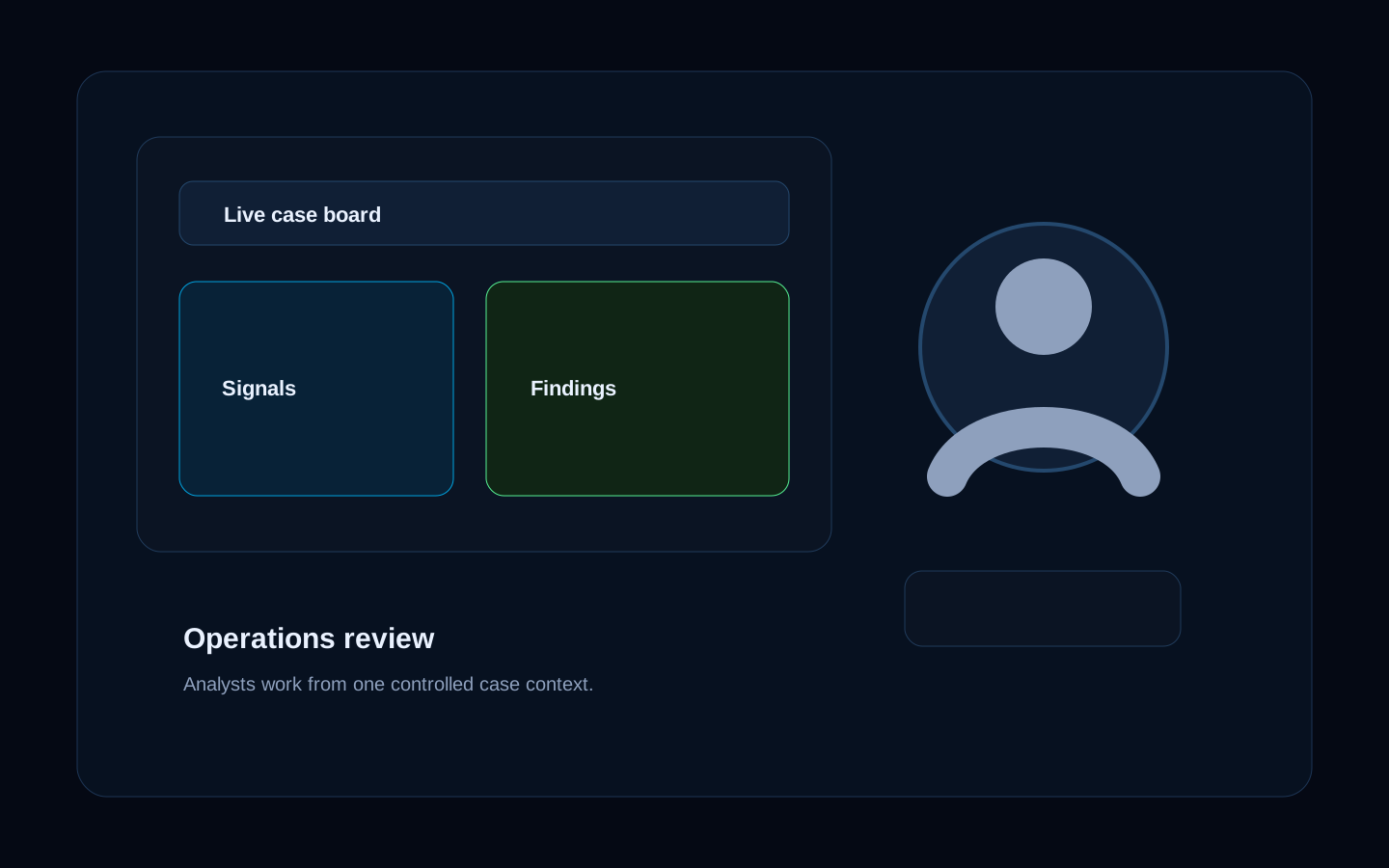
Findings become connected context
What protection teams get back
Faster preparation
Collect and structure relevant signals around the person, place or event the team needs to brief.
Cleaner risk context
Separate relevant relations from raw public noise with source notes and confidence context.
Concise briefings
Produce reviewable outputs for planning, movement and leadership updates.
Controlled claims
Preserve uncertainty and reviewer judgment instead of presenting unsupported predictions.
Where protective intelligence usually breaks
Protection teams need timely context, but the signal stream is noisy: public posts, places, events, mentions and actor references rarely arrive in a useful operational shape.
Arqent structures that work around people, locations and events. Analysts can connect signals, preserve source notes, review confidence and brief the team without turning raw noise into unsupported certainty.
PROBLEM
Signals are noisy
Public posts, locations, events and actor references rarely arrive in a clean protective-intelligence format.
WORKFLOW FIX
Context must be organized quickly
Protected persons, assets, locations, events, source notes and case graph relations are structured around the operation.
OUTCOME
Teams need concise outputs
The workflow produces reviewable protective intelligence outputs for planning, movement and leadership updates.
CONSTRAINT
Certainty cannot be invented
Assessments show relations and source notes – without implying certainty that does not exist.
Use cases
Executive protection workflows this supports
Use connected context for movement planning, situational awareness and protective monitoring.
OSINT
OSINT analysis
Operators collect and assess open sources – usernames, email registrations, domains, social and messaging channels including Telegram, and commercial OSINT such as Fivecast ONYX. Every hit gets a source note and a false-positive check before it becomes a finding.
Explore workflowSystems and sources
What the operator does
Results
OSINT
Account and identity investigations
Username and account signals across platforms are compared, false positives are marked, and the remaining hits are connected into an identity graph with source notes.
Explore workflowSystems and sources
What the operator does
Results
Critical infrastructure
Situational awareness for critical sites
Global events, natural hazards and incidents appear on one live map next to your sites. Geofences with NATO symbology (APP-6) mark what matters, and operators report what changed and what it affects.
Explore workflowSystems and sources
What the operator does
Results
Protection of sites and events
Drone and radio detection
Connected sensors pick up drone Remote ID, aircraft ADS-B, Bluetooth and radio signals. Detections appear on a live map, flights can be tracked, and operators flag what needs attention.
Discuss this use caseSystems and sources
What the operator does
Results
Monitoring
Continuous monitoring
Operators watch targets, topics and sources on a schedule – day and night – and report only what changed, with the evidence attached. Repeated failures escalate to a person.
Discuss this use caseSystems and sources
What the operator does
Results
Protective intelligence
Protection incident review
A concerning mention, event change or incident report goes into a case: sources are reviewed, the escalation is prepared and every decision is recorded.
Discuss this use caseSystems and sources
What the operator does
Results
Travel security
Venue and movement preparation
A route, venue or public appearance gets location context, actor references, open questions and a clear owner for the briefing.
Discuss this use caseSystems and sources
What the operator does
Results
Product view
Keep every briefing tied to the source trail
Signals, notes, reviewer decisions and final briefings remain attached to the operation so teams can understand what changed and why it mattered.
Trigger
Movement, event, mention, report or location change
Assessment
Source review, relation mapping and confidence notes
Decision
Escalate, monitor, brief or dismiss
Output
Protective intelligence briefing with context
EVIDENCE TRAIL
Every result stays linked to its sources
Trust model
Built for careful protective assessments
Protective intelligence workflows must support speed without inventing certainty or exposing sensitive context too broadly.
Source discipline
Keep raw public signals and analyst interpretation distinct.
- Source notes
- Confidence context
- Open questions
Operational boundaries
Limit sensitive person, route and location context by role.
- Role access
- Case boundary
- Need-to-know sharing
Review path
Make briefings accountable before they affect protection plans.
- Human review
- Decision trail
- Briefing context
Deployment fit
Run where the protection mission requires.
- On-premises
- Airgapped
- Role-based sharing
Map a protective intelligence workflow
Define assets, locations, signal sources, review rules and output requirements.