Controlled AI. Real results.
Package repeatable workflows without rebuilding the foundation
Solution builders usually know the domain workflow. What slows delivery is rebuilding case management, evidence handling, permissions, tool policy and deployment scaffolding for every customer.
Product view
Package domain workflows on top of the Arqent foundation
Solution builders can focus on the buyer problem while Arqent provides the shared case, evidence, governance, policy and deployment layer underneath.
Capability
Data source, tool, dashboard or workflow
Package
Buyer trigger, intake, review path and output
Govern
Policies, evidence handling and versioning
Deploy
SaaS, on-premises or airgapped
SOLUTIONS
Capabilities become installable solutions
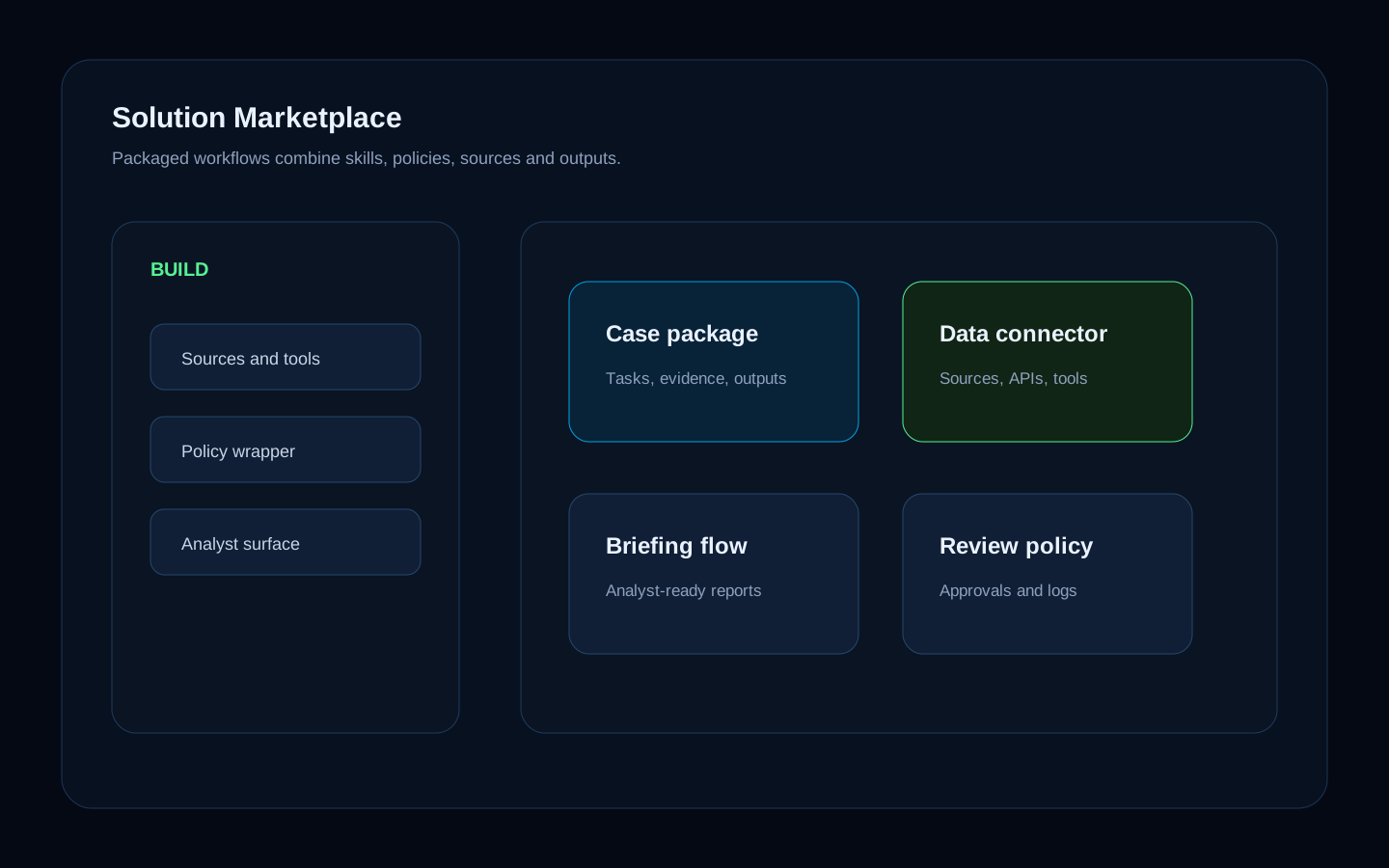
What builders get back
Faster packaging
Turn a capability into a buyer-ready workflow without rebuilding case management or evidence handling.
Clear buyer outcomes
Describe the trigger, workflow, expected output and constraints each Solution is designed to solve.
Governance included
Ship policy defaults, review gates, audit context and deployment assumptions with the package.
Repeatable delivery
Adapt the same Solution pattern across industries and customer environments.
Where Solution delivery usually breaks
A strong data source, model, tool or service is not automatically a regulated customer workflow. Buyers still need intake, access control, evidence handling, review, outputs and deployment assumptions.
Arqent gives builders that foundation. Tools, dashboards, data flows and policies can be packaged around a concrete problem so teams ship repeatable Solutions instead of bespoke scaffolding.
PROBLEM
Good capabilities are hard to ship
A service or data source is not yet a customer-ready workflow until it has intake, review, output and governance paths.
WORKFLOW FIX
Packaging needs structure
Tools, dashboards, data access, policies and outputs are packaged around a defined industry problem.
OUTCOME
Customers buy outcomes
The package explains the buyer trigger, operational workflow, expected output and required controls.
CONSTRAINT
Every environment differs
Deployment assumptions, policy defaults and limitations travel with the workflow and are verified per customer.
Use cases
Builder workflows this supports
Use the marketplace path to package governed tool orchestration and reusable intelligence workflows for regulated customers.
Platform teams
External tool orchestration
Your team already owns tools and data sources. Arqent wraps them as governed tools: a policy check before every call, a full execution history and results that land in the case.
Explore workflowSystems and sources
What the operator does
Results
Investigations
Case-native investigations
From the first lead to the final briefing, operators collect, enrich and correlate inside the case. Sources, findings, analyst decisions and reports stay in one record instead of chats, spreadsheets and point tools.
Explore workflowSystems and sources
What the operator does
Results
OSINT
OSINT analysis
Operators collect and assess open sources – usernames, email registrations, domains, social and messaging channels including Telegram, and commercial OSINT such as Fivecast ONYX. Every hit gets a source note and a false-positive check before it becomes a finding.
Explore workflowSystems and sources
What the operator does
Results
Threat intelligence
Darknet intelligence
Find and map onion services, marketplaces, vendors and indicators – with darknet search, an isolated Tor browser and analysis of the Tor relay network. Collection stays governed, and every artifact stays attached to the case.
Explore workflowSystems and sources
What the operator does
Results
Fraud and DFIR
Email forensics and BEC
A suspicious email is analysed – headers, domains, links and attachments – enriched, correlated with the case and turned into a report a reviewer can stand behind.
Explore workflowSystems and sources
What the operator does
Results
Product view
Turn capabilities into governed customer workflows
Each packaged Solution can define which tools run, who approves them, what evidence is captured and how reviewers handle the output.
Inputs
Customer data, sources, tools and operational triggers
Policies
Access, tool limits, approvals and audit defaults
Outputs
Reports, dashboards, case graphs or evidence packages
Lifecycle
Version, deploy, monitor and improve
TOOL GOVERNANCE
Every tool call passes a policy first
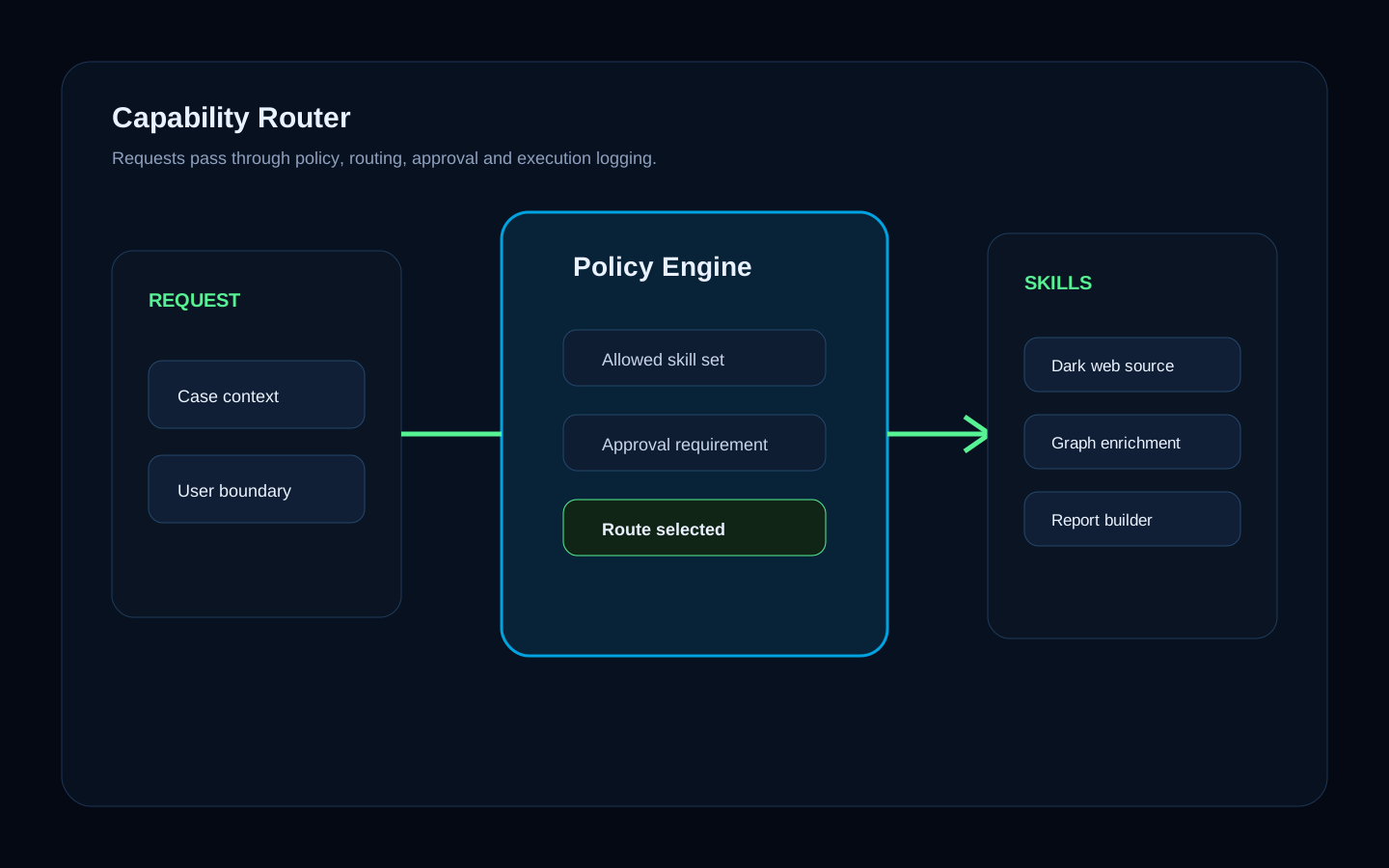
Trust model
Built for regulated Solution packaging
Builders need a packaging model that carries governance, evidence and deployment assumptions with the workflow.
Package definition
Make the buyer problem, workflow and output explicit.
- Buyer trigger
- Workflow steps
- Expected output
Governance defaults
Ship controls alongside the capability instead of adding them later.
- Tool policy
- Review gates
- Audit logs
Evidence model
Preserve the artifacts and decisions needed for regulated review.
- Artifacts
- Replay path
- Decision record
Deployment path
Keep hosting and connectivity assumptions visible per customer.
- SaaS
- On-premises
- Airgapped
Start a Solution builder conversation
Bring the capability, data source or workflow you want to package for regulated customers.